A document marked “PAID”, “COPY”, “CONFIDENTIAL” or “RECEIVED” should not need typing, handwriting or a second check every time it crosses a desk. Office stamps turn routine decisions into a clear, repeatable action, helping busy teams process paperwork quickly while keeping records easy to follow.
For a small business, school office, legal practice or accounts department, the benefit is not simply speed. A well-chosen stamp creates consistency. Everyone sees the same wording, in the same place, with a clean impression that is difficult to miss. That can reduce filing errors, clarify responsibility and give customer-facing documents a more professional finish.
Where Office Stamps Earn Their Keep
Office work often involves small tasks repeated dozens of times a day. Incoming post needs a date, invoices need an approval status, copies need identifying, and forms may need to be returned with a short instruction. Writing those details by hand is slow and can be inconsistent, especially when several people share the workload.
A date stamp is a straightforward example. It gives every incoming document a legible receipt date, which is useful when tracking supplier invoices, customer correspondence, applications or complaints. In a busy office, that date can be the difference between finding a document quickly and working backwards through an uncertain pile of paperwork.
Status stamps are equally useful. “PAID”, “APPROVED”, “URGENT”, “FILE COPY” and “ACTION REQUIRED” make the next step obvious without needing an extra note. They are particularly effective where documents move between reception, accounts, management and filing. The wording acts as a visual prompt, so less information is lost in handovers.
Custom office stamps allow a business to add its own details, such as a company name, address, telephone number, bank details or returns instructions. These are practical for order forms, delivery notes, receipts and paperwork that needs the same contact information repeatedly. The right design saves time while avoiding the untidy appearance of a handwritten addition.
Choose the Stamp Type Around the Job
The best stamp is not always the largest one or the one with the most text. It needs to suit the frequency of use, the amount of information required and the documents being marked.
Self-inking stamps for regular use
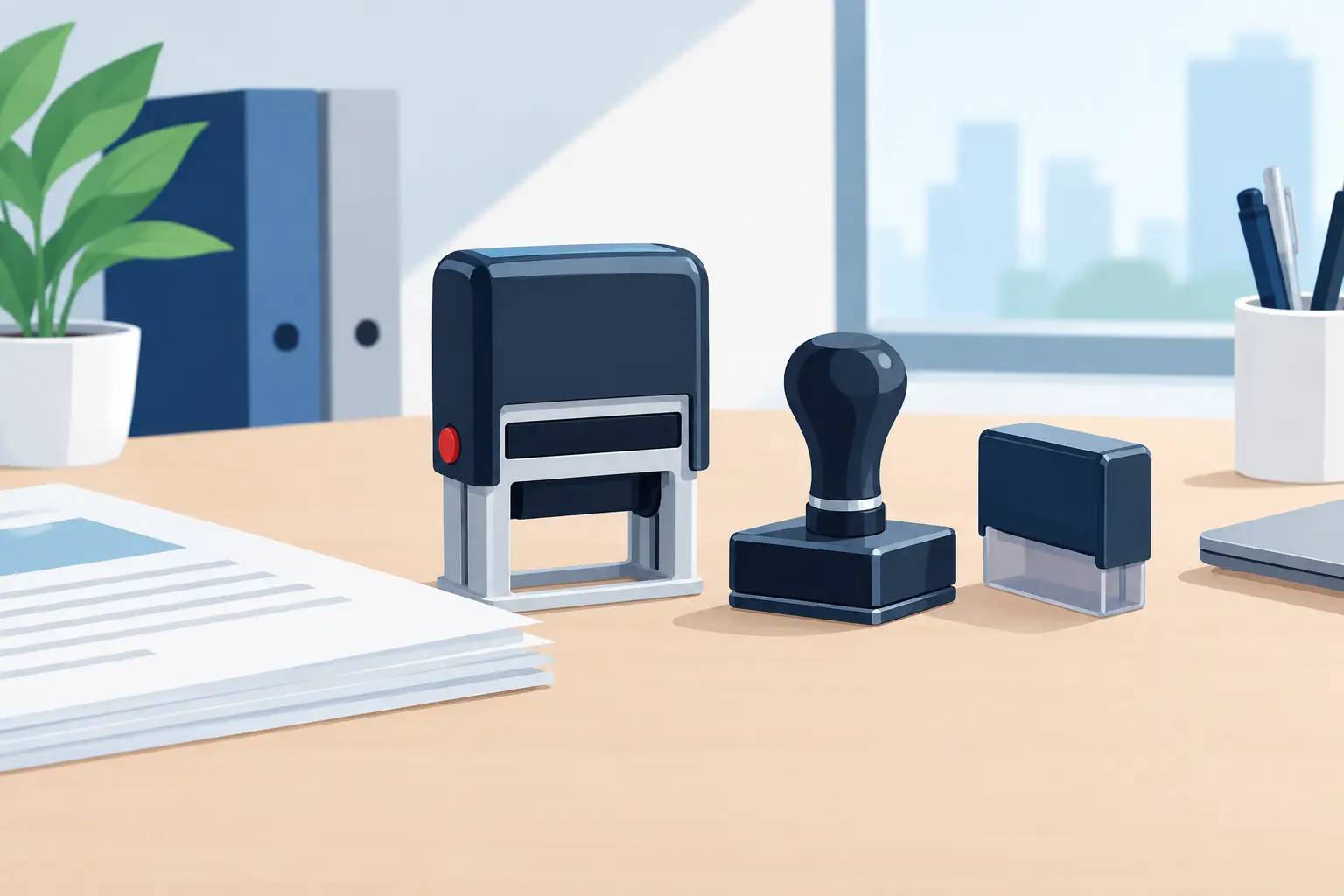
A self-inking stamp is usually the sensible choice for daily administration. Its built-in ink pad re-inks the die after each impression, so it is quick to use and does not require a separate pad on the desk. For reception desks, accounts teams and shared office spaces, this means cleaner hands, faster stamping and a consistent result over many impressions.
They work well for common phrases, addresses, signatures, dates and simple approval marks. When the pad eventually becomes dry, it can normally be replaced or re-inked rather than replacing the whole stamp. This makes self-inking models a practical option for repeat-use tasks.
Traditional rubber stamps for flexibility
Traditional rubber stamps require a separate ink pad, but they still have a place. They are useful when you need different ink colours, when the stamp is used only occasionally, or when marking unusual surfaces. A separate pad also gives more choice over ink type, which can matter for specialist forms, packaging or materials that need a more permanent impression.
The trade-off is that they take an extra step and can be messier in a shared workspace. For routine paper documents, self-inking stamps are generally more convenient. For occasional use or a specific ink requirement, a traditional stamp may be the better fit.
Date stamps for clear records
A date stamp is one of the most useful tools in a paper-based workflow. Adjustable date bands allow the date to be changed each day, while some styles include room for wording such as “RECEIVED” or “PAID”. This keeps document history visible without relying on someone to write the date clearly and correctly.
Before ordering, consider the date format your organisation uses. UK offices will usually prefer day-month-year, particularly where documents are shared with customers, suppliers and colleagues. A clear format helps avoid the confusion that can arise with numbers such as 05/04/26.
Get the Wording Right Before You Order
A stamp can only save time when its wording is immediately useful. Start with the action you repeat most often. If staff regularly write “Received on”, a dated stamp with that phrase is likely to be more useful than a general-purpose design. If invoices are passed to a manager, “Authorised for Payment” with space for initials may be a better choice than a simple “Approved”.
Keep the message concise. Long blocks of text may technically fit, but small lettering can be hard to read and may not reproduce well on thin or uneven paper. A short instruction, a clear status and enough room for a signature or date will often do more than an overloaded stamp.
For custom company details, check every line before submitting the order. Confirm spellings, postcodes, telephone numbers and any registration details. Consider whether the information will still be current in a year or two. A generic “Accounts Department” stamp may remain useful longer than one that includes an individual’s name.
Layout matters too. The most important words should be prominent, with supporting information below. If you need to stamp forms with boxes or fields, measure the available space first. An impression that runs over a signature line or obscures key information creates more work than it removes.
Ink Colour, Size and Placement Matter
Black ink is the dependable choice for most office stamps because it is clear, professional and easy to photocopy. Blue can help distinguish an original from a copy, while red is useful for attention-grabbing messages such as “URGENT” or “OVERDUE”. Used too widely, however, red can make a document look cluttered or overly alarming. Reserve it for statuses that genuinely need attention.
The stamp size should match the job. A small date impression suits incoming post and invoices. A larger rectangular stamp is better for a return address, payment instruction or several lines of company details. If the document is customer-facing, test the position before adopting a standard process. Stamping in the same place each time makes paperwork quicker to scan and easier to file.
Where possible, make a test impression on the actual paper stock you use. Glossy, recycled, lightweight and heavily textured papers can all take ink differently. A crisp stamp on standard copier paper may look less sharp on a coated delivery note. Testing avoids surprises when the stamp becomes part of a regular process.
Build Stamps Into a Sensible Workflow
Office stamps work best when staff know what each one means and when to use it. A “PAID” mark should only be applied after the payment has been confirmed. A “RECEIVED” stamp should be placed on incoming documents as they arrive, not added later in batches when the true receipt date may be unclear.
Keep the most-used stamps close to the point of work. Reception staff may need a date received stamp beside incoming post. Accounts may need payment and approval stamps near invoice trays. A shared cupboard can seem tidy, but stamps that are hard to reach are less likely to be used consistently.
It is also worth reviewing stamps as processes change. If a business moves to digital approvals, an “APPROVED” stamp may no longer be necessary, while a stamp for scanning, filing or customer returns could become more valuable. The aim is not to stamp everything. It is to mark the moments where a visible, standard instruction improves the flow of work.
Ordering for a Team or Several Locations
If several people or sites need the same impression, ordering identical stamps avoids small differences in wording and layout. This is useful for branches, school departments, multi-site service businesses and offices where documents may be transferred between teams. Consistent marking supports consistent records.
Bulk ordering can also make sense for organisations setting up new desks or replacing worn equipment. Keep one spare for a high-use stamp, particularly a date stamp or payment status stamp. A missing stamp may seem minor, but it can interrupt a process that relies on a clear audit trail.
Handy Stamps provides practical custom options for businesses that need repeat-use marking tools without a complicated ordering process. For everyday administration, the priority is simple: select wording that matches the task, choose a durable format, and make it easy for staff to use correctly.
A good office stamp should quietly remove a repetitive job from the day. When the wording is clear, the impression is reliable and the stamp sits where the work happens, paperwork moves on with fewer delays and fewer questions.