An invoice arrives without a purchase order number, a payment request needs approval, and a paper file is waiting to be archived. These are small jobs, but repeated across a busy week they create avoidable delays. The right essential stamps for accountants give finance teams a quick, consistent way to show what has happened to a document and what needs to happen next.
For firms, in-house finance departments and bookkeepers, a stamp is not a substitute for accounting software or proper controls. It is a practical companion to them, especially where paper documents, signed forms and physical filing still play a part. A clear impression can reduce handwritten notes, make a document easier to follow and help colleagues act without having to ask for clarification.
Why stamps still earn their place in finance offices
Many accounting processes are digital, but paper has not disappeared. Supplier invoices may arrive by post, expense claims may need signatures, and client records may include original documents that must be retained. Even a scanned document benefits from clear marking before it is filed or passed on.
Stamps bring consistency to repetitive decisions. Rather than writing “paid”, adding the date and initialling each invoice by hand, a member of the team can apply the same wording in seconds. The result is neater, easier to read and less dependent on individual handwriting.
They are particularly useful where more than one person handles a document. A well-chosen stamp shows whether an invoice has been received, checked, approved or paid. That visible trail supports day-to-day organisation, although it should always sit alongside your firm’s approval rules, records policy and digital audit trail.
The essential stamps for accountants
The best selection depends on how your office handles invoices, expenses, client paperwork and post. A small practice may need only a few core designs, while a larger finance team may benefit from several department-specific stamps. These are the options that solve the most common tasks.
1. Received date stamps
A received stamp records the date a document entered the business or finance department. It is useful for supplier invoices, client correspondence, tax forms and any paperwork with a response deadline.
A self-inking date stamp is usually the most practical choice for frequent use. The date can be adjusted daily, and the built-in ink pad keeps the desk tidy. Add wording such as “Received” or “Date Received” if documents are handled by several departments before reaching accounts.
This simple mark can help teams identify invoices that have been sitting in a tray too long. It also gives context when a supplier asks when their paperwork was received.
2. Invoice processing stamps
An invoice processing stamp creates a clear area for the information your team needs before payment. Typical fields include supplier, invoice number, date received, purchase order number, nominal code, VAT amount, authorised by and payment date.
This is often the most valuable custom stamp for a paper-based invoice workflow. It keeps key details in one predictable place instead of being scattered across the page in notes and signatures. It can also reduce the risk of an invoice being entered without a purchase order reference or correct coding.
The trade-off is space. A detailed layout works best on A4 invoices with clear margins. If suppliers often send small receipts or compact invoices, choose fewer fields and larger writing boxes. A stamp that is too crowded is less useful than a simple one people can complete quickly.
3. Approved and authorised stamps
Approval stamps make it immediately clear that a document has passed the required check. “Approved for Payment”, “Authorised”, “Checked” and “Passed for Payment” are common choices, depending on the wording used in your internal process.
For stronger accountability, include a space for initials, signature and date. This is helpful where a budget holder approves a cost and the accounts team then schedules the payment. It avoids ambiguity between an invoice that has merely been seen and one that has actually been authorised.
Do not use a generic approval stamp to bypass your existing controls. The stamp should reflect an approval already given by the correct person, not create one. Where electronic approval is required, it can still be useful for marking the supporting paper copy or related delivery note.
4. Paid stamps
A “Paid” stamp prevents a surprisingly common administrative problem: a document being picked up twice because its status is unclear. It works well on supplier invoices, petty cash vouchers and expense claims once payment has been made and recorded.
A version with lines for payment date, method and reference number is especially useful. For example, the finance team can add the BACS reference, cheque number or card transaction reference beside the stamp. That makes later queries quicker to resolve without searching through several systems.
Use this stamp only at the final stage. Marking an invoice as paid when it has merely been entered onto a payment run can cause confusion, particularly when payment dates change.
5. Copy and duplicate stamps
“Copy”, “Duplicate” and “Original” stamps are modest but useful tools for document control. They help stop duplicate invoices being processed and ensure the right version is retained in the correct file.
These stamps are useful for client packs, signed engagement documents, purchase records and internal copies of correspondence. A bold, simple design is usually best, as the purpose is instant recognition rather than detailed information.
For invoices, a duplicate stamp should prompt a check against the accounting system before any action is taken. It is a visible reminder, not proof that an invoice has already been paid.
6. Confidential stamps
Accountants routinely handle information that should not be left on an open desk or passed around unnecessarily. A “Confidential” stamp is useful for payroll papers, bank details, tax returns, employee records and sensitive client correspondence.
It will not replace secure storage or data protection procedures, but it helps signal the level of care expected when paper changes hands. This is particularly helpful in shared offices, reception areas and businesses where post is opened before it reaches the accounts team.
7. Filed and scanned stamps
A “Filed” or “Scanned” stamp helps close the loop on documents that have been entered into a digital system and stored according to your process. It can be useful for invoices, receipts, bank correspondence and client documents where the original needs to be retained.
Choose the wording carefully. “Scanned” confirms a digital copy has been made, but not necessarily that it has been checked or posted to the ledger. “Filed” may mean a physical document has been placed in storage. Separate stamps can be clearer when those are distinct stages in your workflow.
8. Expense and petty cash stamps
Expenses and petty cash often involve several pieces of information: who incurred the cost, what it was for, the amount, VAT treatment, cost centre and approval. A dedicated stamp brings those details together on a claim form, receipt or voucher.
For a small business, a straightforward petty cash stamp with date, amount, purpose and signature lines may be enough. Larger organisations may need a custom layout that includes department codes or project references. The aim is to make review easier, not to turn a receipt into an unreadable form.
9. Returned or query stamps
Not every document is ready to process. A “Query”, “Information Required” or “Returned” stamp gives a clear reason why paperwork has been sent back. It is useful when an invoice lacks a purchase order number, an expense claim has no receipt or a form has not been signed.
Include a space for a brief note and the date. This reduces repeated chasing and gives the recipient a clear action to take. It also helps the accounts team show why a payment was delayed if the question arises later.
Choosing the right stamp format
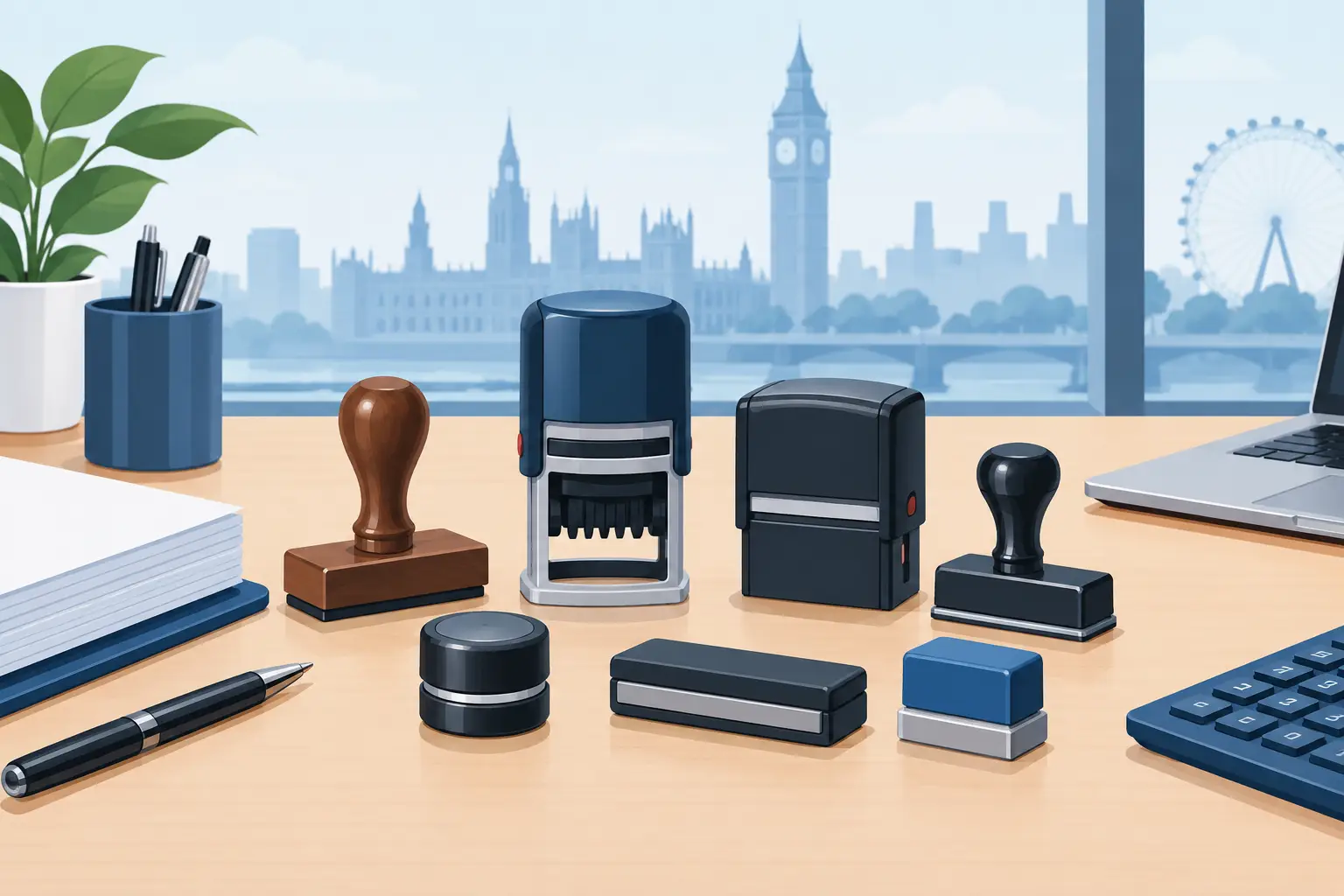
For most accounting desks, self-inking stamps are the sensible default. They are quick to use, produce consistent impressions and suit high-volume tasks such as dating, approving and marking invoices as paid. They also keep the ink pad enclosed when not in use.
Traditional rubber stamps can be a better fit for larger custom layouts, especially invoice processing boxes that need to be applied across a wide area. They require a separate ink pad, which adds one more item to manage, but they offer flexibility in size and design.
Think about the paperwork before ordering. Check the smallest documents your team handles, the space available on typical invoices and whether the stamp needs room for handwritten notes. Black ink is usually the clearest choice for formal records, while a different colour can help approval or query marks stand out. If colour is used, make sure it still reproduces clearly when documents are photocopied or scanned.
Set stamps around a clear process
A stamp works best when everyone knows what it means and when to use it. Keep the wording aligned with your actual process. If the payment team uses “Approved for Payment”, do not order a stamp that says “Paid” for the approval stage.
It is worth agreeing a small set of standard marks with the people who open post, code invoices, approve spend and file records. Store the stamps where they are needed, keep spare ink or replacement pads available, and replace worn impressions before they become difficult to read.
Handy Stamps can produce practical standard and custom designs for finance teams that need repeated, consistent marking without adding unnecessary steps. Start with the points where paperwork most often slows down, then choose stamps that make the next action obvious.