A stamp that saves ten seconds but produces a faint, uneven mark soon becomes a daily irritation. This Colop Printer stamp review looks at what the range does well in real working environments: repeated marking, clear custom text and clean handling. For offices, schools, garages and small businesses, the appeal is simple – a self-inking stamp that gives consistent results without needing a separate ink pad.
The Colop Printer range is designed for practical, routine use. It covers compact address stamps through to larger formats for business details, signatures, inspection records and multi-line messages. The right choice depends less on the brand name than on the amount of text, the available space on the document and how often the stamp will be used.
What a Colop Printer Stamp Is
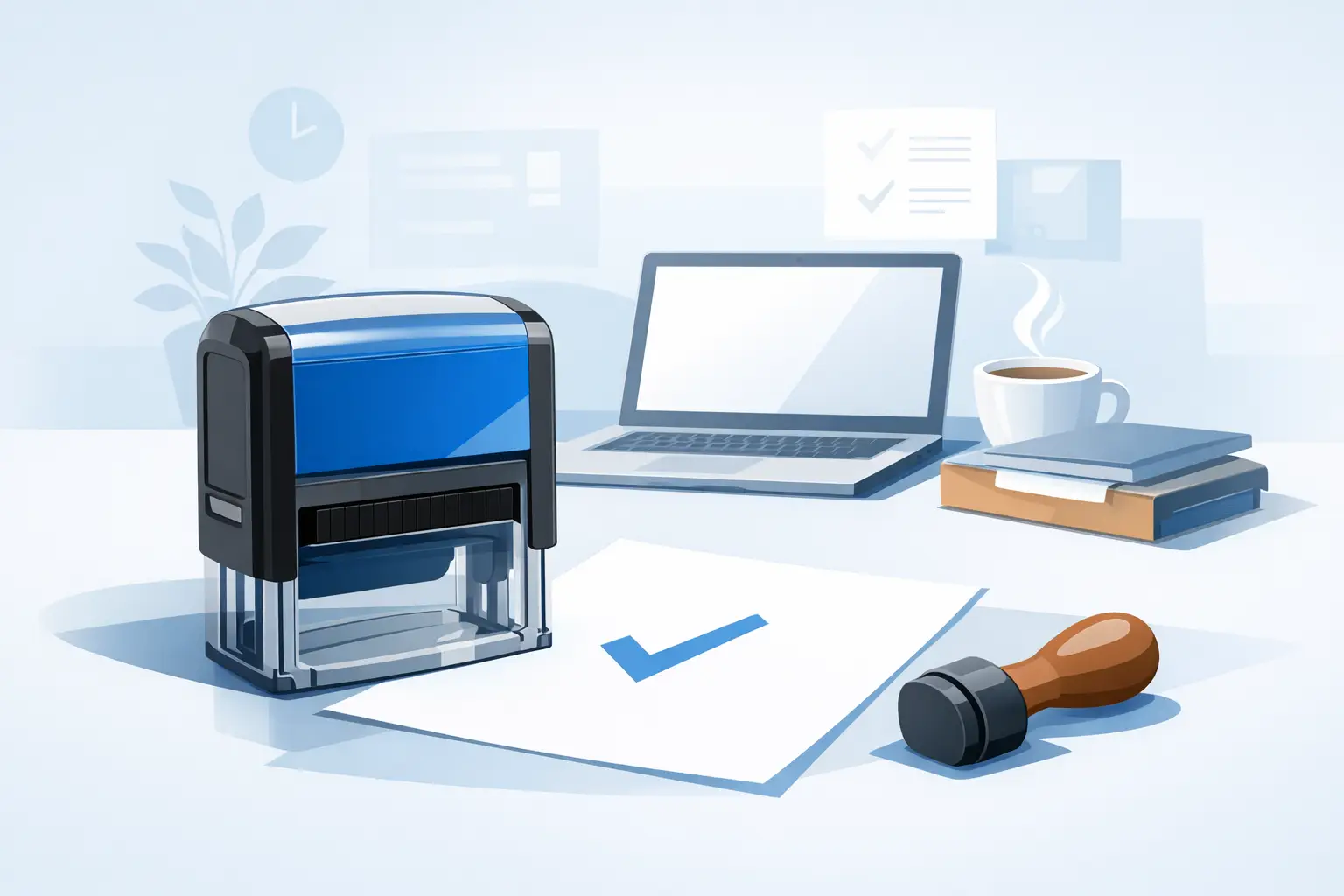
A Colop Printer is a self-inking stamp. The rubber text plate sits inside a plastic housing and turns against an internal ink pad when pressed. After each impression, the plate returns to the pad ready for the next use.
That mechanism keeps the process tidy and quick. Unlike a traditional hand stamp, there is no separate pad to position, no risk of pressing too heavily into an exposed pad, and no need to re-ink between individual impressions. For someone processing invoices, marking exercise books or applying company details to paperwork, this makes a noticeable difference over a busy day.
Most Printer models use a rectangular text plate, although the wider Colop range also includes other shapes and specialist formats. The Printer line is especially suited to information that needs to be read quickly: names, addresses, telephone numbers, approval messages, dates and short instructions.
Colop Printer Stamp Review: The Practical Strengths
The main strength is consistency. A good self-inking stamp should put down an even impression with ordinary hand pressure, and Colop Printer stamps are generally dependable in this respect when the plate is correctly made and the pad is adequately inked. Text remains clear across repeated use, which matters where a stamp is part of a record-keeping process rather than an occasional convenience.
The housing is also built for ordinary desk use. It is compact enough to store in a drawer, stable enough to use one-handed and designed to keep ink contained inside the unit. This is particularly useful in shared offices and classrooms, where loose ink pads can end up misplaced or mark surrounding surfaces.
Another practical advantage is the range of sizes. A small model works well for initials, a short reference or a compact return address. Mid-sized versions suit standard business contact details and common office messages such as PAID, RECEIVED or COPY. Larger Printer stamps can hold several lines of text and are more appropriate for full address blocks, terms, handling instructions or garage service information.
Choosing the size carefully is important. Trying to squeeze eight or nine lines onto a small stamp can make the final impression difficult to read, even if the engraving itself is accurate. In most cases, a slightly larger plate with clear type is more useful than a cramped design that technically includes every detail.
Clear impressions depend on the artwork
The stamp body is only part of the result. The quality of the artwork, type size and layout has a direct effect on legibility. Simple sans-serif lettering, sensible spacing and a clear hierarchy between a business name and contact details usually produce the best working stamp.
Fine decorative fonts, very small characters and detailed logos can be reproduced, but they are not always the best fit for a high-volume administrative stamp. If the stamp will be used on carbonless forms, textured paper or documents with pre-printed lines, bold and uncomplicated text is more forgiving.
A black impression remains the most versatile option for formal paperwork, filing and everyday administration. Blue, red, green and violet can be useful where colour has a purpose, such as separating departments, identifying checked work or flagging action required. Colour should support the process, not make the stamp harder to read or reproduce on a photocopy.
Where Colop Printer Stamps Work Best
For office administration, a customised Printer stamp can reduce repetitive handwriting and keep documents uniform. Address stamps, bank-detail stamps, reference stamps and approval messages are straightforward examples. A staff member can apply the same information each time without checking spelling or leaving a rushed handwritten note.
Schools can use them for feedback phrases, reading records, homework checks and departmental administration. Teachers should consider how much wording pupils can take in at a glance. A short message such as “Well Presented”, “Please Correct” or “Reading Record Checked” often works better than a full sentence in small text. For more varied feedback, several smaller stamps may be quicker than one oversized stamp containing too many phrases.
Garages and workshops benefit from stamps that make service paperwork easier to complete. A stamp can add company details, mileage prompts, next-service reminders or inspection wording to job sheets and customer records. Here, durability and a legible design are more valuable than decorative presentation. Use a larger format if mechanics or service advisers need to read it quickly in a busy reception area.
Retailers, clubs and event organisers can also use the range for loyalty cards, entry marking and back-office paperwork. For loyalty schemes or frequent hand marking, however, it is worth checking the card stock first. Smooth coated cards may need a suitable ink choice or a short drying time to avoid smudging.
Refill Pads, Ink and Ongoing Cost
A self-inking stamp is not a disposable item. When impressions start to look pale, the usual answer is to replace or re-ink the internal pad rather than replace the whole stamp. This gives the Colop Printer range a sensible long-term cost for regular users.
The best approach is to use the correct refill pad or compatible ink specified for the model. Adding too much ink can flood the pad and create blurred, heavy impressions. Too little leaves parts of the text weak. Replacing a worn pad is often cleaner and more predictable, especially for stamps used heavily every working day.
Ink can also dry out if a stamp is left unused for a long period or stored where it is exposed to heat. Keeping the stamp closed in its normal resting position and away from radiators or direct sunlight helps maintain the pad. If a stamp is used only occasionally, test it on scrap paper before marking an important document.
This is one area where a basic hand stamp may still suit some buyers. A traditional rubber stamp and separate pad can be economical for very large impressions, unusual ink types or specialist surfaces. It is also easier to swap ink colours quickly. The trade-off is slower use and greater potential for mess. For standard paper-based work, a Colop Printer is usually the more convenient option.
Limits to Consider Before Ordering
No single stamp style suits every job. The plastic self-inking housing is intended for paper and card, not rough timber, uneven packaging, fabric or awkward curved surfaces. For those materials, a traditional hand stamp or a specialist marking solution may be more appropriate.
The range also has physical limits on text plate size. A large company logo, extensive terms and conditions, several phone numbers and a full address may not belong on one stamp. Splitting the information across two stamps can be faster to use and easier for customers or colleagues to understand.
If the document requires a date that changes daily, a dater stamp is usually a better choice than ordering a static text stamp. Similarly, a numbering stamp is more suitable for sequential paperwork. A custom Printer stamp can sit alongside these tools, but it should not be asked to do a job that an adjustable stamp handles better.
For signatures, consider whether the organisation accepts a stamped signature for that specific process. A signature stamp can save time for authorised routine paperwork, but it should be securely stored and used only within the relevant internal controls.
Choosing the Right Colop Printer Model
Start with the finished impression, rather than the stamp body. Measure the space on the form, envelope, label or card where the mark needs to sit. Then decide how many lines are genuinely necessary and whether a logo is essential. This prevents the common mistake of buying a compact stamp for information that needs a larger format.
Next, think about frequency of use. A small address stamp used a few times a week has different demands from a large office message stamp used hundreds of times. Regular users should prioritise a comfortable housing, a generous text area and readily available replacement pads.
Finally, check the proof carefully before production. Names, postcode formatting, phone numbers, email addresses and registration numbers are simple details, but errors are repeated every time the stamp is pressed. A clear proof is the easiest point at which to adjust spacing, line breaks and type size. Handy Stamps can help customers select a practical size when the intended use is clear.
A Colop Printer stamp is a sound choice when the task is repeated, paper-based and needs a neat, standard result. Keep the wording readable, match the size to the space available and maintain the ink pad properly. The best stamp is not necessarily the one that holds the most information – it is the one that makes the next hundred impressions quicker and clearer.