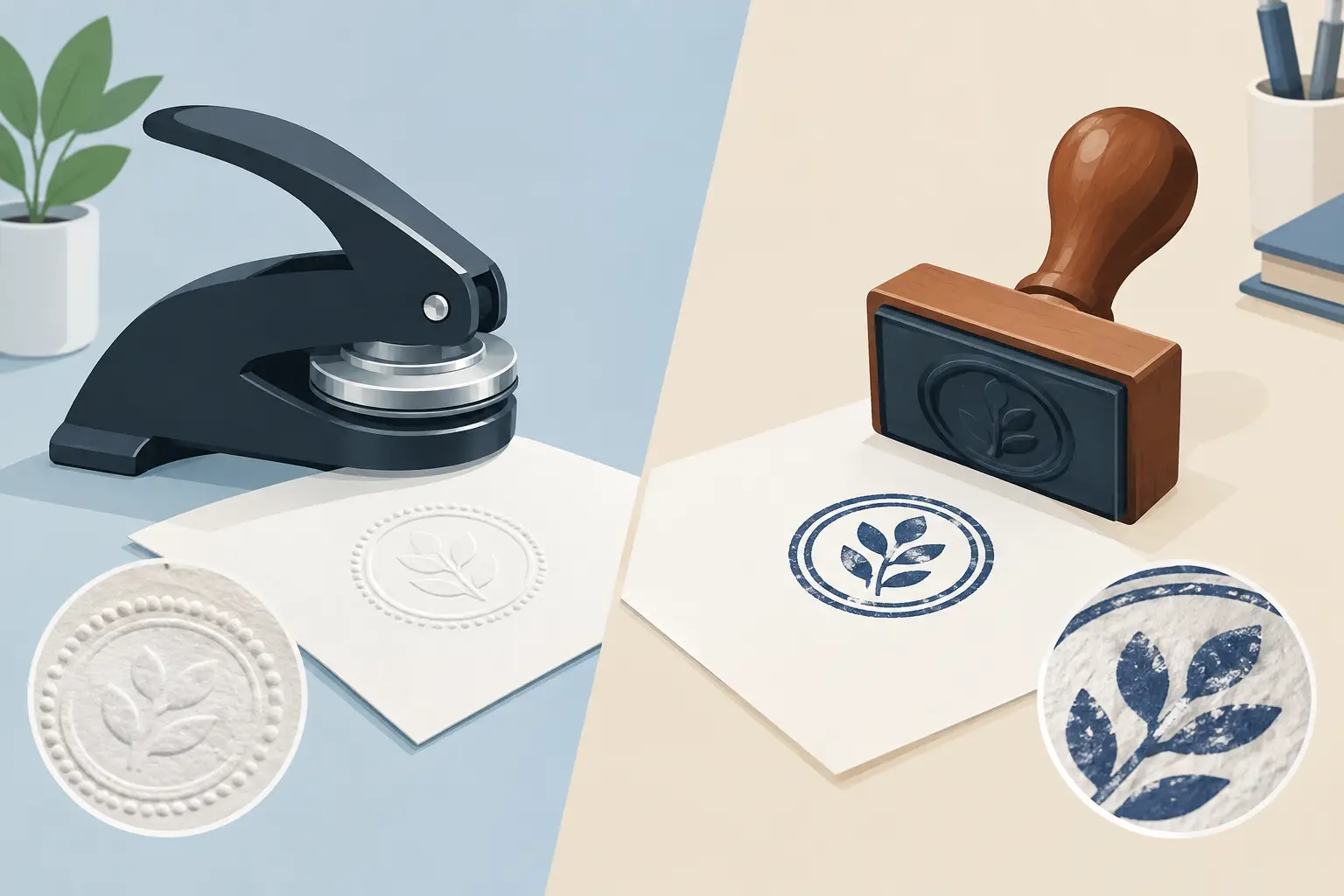
A raised seal can make a certificate feel official. A clear ink impression can process fifty invoices before lunch. The embosser versus stamp choice comes down to what you are marking, how often you need to do it and whether the mark needs colour, permanence or visual impact.
For most everyday office, school, retail and trade tasks, a stamp is the quicker and more flexible option. An embosser has a more specialised role, but it can be exactly right for formal paperwork, membership documents and premium printed materials.
Embosser versus stamp: the core difference
An embosser uses pressure rather than ink. It presses a design into paper or thin card, leaving a raised impression on one side and an indented impression on the other. The result is tactile, clean and permanent because there is no ink to fade, smudge or run.
A stamp transfers ink from a rubber die to the surface being marked. Self-inking stamps keep the ink pad inside the unit, making them particularly useful for repeated work. Traditional hand stamps use a separate ink pad and can offer greater flexibility with ink colours and specialist inks.
That basic difference affects everything from the materials you can mark to the speed of the job. A stamp is designed for visible information: a date, address, approval message, teacher feedback, logo or loyalty mark. An embosser is designed for a formal, texture-based impression.
When an embosser is the better choice
Embossers work best on good-quality paper and lightweight card. They are commonly used for certificates, official correspondence, book ownership marks, legal or professional stationery, club documents and invitations. A raised seal gives a document a distinctive finish without adding another colour to the page.
This is particularly useful where an inked mark might look too bold or distract from carefully printed artwork. A wedding invitation, for example, may suit a discreet embossed monogram better than an ink stamp. The same applies to premium letterheads, presentation certificates and documents intended to be kept.
An embosser is also useful where you want a mark that cannot be accidentally smeared. Once the impression has been pressed, there is no drying time and no ink supply to manage. It is a tidy option for occasional use at a desk.
There are limits. Embossing is not suitable for every material, and heavy card may be difficult to press cleanly. It can also be harder to see in poor light, especially on white paper. If people need to read the wording quickly, an ink stamp is normally the more practical choice.
A note on formal use
An embossed seal can add authority to a document, but it does not automatically make that document legally binding. If you are using one for company, legal or professional paperwork, make sure the wording and process meet the requirements of your organisation or profession. The embosser provides a physical mark, not legal status by itself.
When a stamp is the better choice
Stamps are built for routine marking. An office administrator can mark incoming post, paid invoices and copies quickly. A teacher can give consistent feedback across a set of books. A garage can add service details to a record booklet, while a café can mark loyalty cards at the till.
The major advantage is clarity. Ink creates an immediate, high-contrast impression that is easy to spot, scan and understand. You can include text, simple logos, dates, boxes for handwritten details or combinations such as “Received”, “Checked” and “Approved”.
A self-inking stamp is often the best all-round format for frequent use. The mechanism re-inks the die after each impression, helping produce a consistent result without reaching for a separate pad. It keeps hands and desks cleaner too. For lower-volume work, larger designs or unusual ink colours, a traditional hand stamp may make more sense.
Stamps are also more versatile across materials, although results depend on the ink. Standard office ink is intended for paper and card. Specialist inks may be needed for glossy surfaces, plastics or other non-porous materials. Always consider the surface before ordering, particularly if the mark needs to resist handling or moisture.
Compare the practical factors before ordering
The right choice is rarely about which product looks better in isolation. It is about how it fits into the work you need to do.
Speed and volume
If you need dozens or hundreds of impressions each week, choose a stamp. A self-inking model is quick to use, easy to keep at a workstation and designed for repeat tasks. An embosser requires more physical pressure and is better suited to smaller batches or individual documents.
For a school office stamping forms, a shop stamping loyalty cards or a business processing paperwork, ink will save time. For signing off a small number of certificates, embossing may be perfectly manageable.
Visibility and information
Use a stamp when the message must be read at a glance. Ink gives you contrast and supports more detailed wording. This is why date stamps, address stamps, inspection stamps and teacher stamps remain practical working tools.
Use an embosser when the impression itself is the point. A seal can carry a name, initials, logo or crest, but fine detail may not reproduce as clearly as it would in ink. Keep embossed artwork simple, with sensible spacing and strong lettering.
Appearance and brand presentation
An embosser has a formal, understated appearance. It suits documents where texture and presentation matter more than immediate visibility. It can feel considered and traditional without being decorative for its own sake.
A stamp can be formal too, but it is more direct. A crisp logo stamp on packaging, bags or cards can reinforce a small business brand at low cost. For events, a hand stamp offers an efficient way to identify paid entry or returning guests. The best option depends on whether you want a subtle seal or an obvious mark.
Running costs and upkeep
An embosser has no ink pad to replace. Its ongoing maintenance is minimal, although the mechanism should be stored safely and kept clean. The initial cost may be worthwhile if you use it for a long-running formal purpose.
A stamp needs ink, and eventually a replacement pad or a new unit depending on its type. That is not usually a major cost, especially for a self-inking stamp used regularly. It is simply part of keeping a high-volume marking process running properly.
Paper and material suitability
Embossers are mainly for paper and thin card. They are not a general-purpose option for boxes, plastic, fabric or uneven surfaces.
Stamps give you more options, but only with the correct ink and a suitable surface. Absorbent paper is the easiest material to mark. Coated stock can need a slower-drying ink, and curved or textured surfaces may not take a full impression. If the application is unusual, test the material before committing to a large order.
Choosing a design that works
Whether you choose an embosser or stamp, the design needs to suit the tool. Avoid trying to fit too much into a small marking area. Tiny text, narrow gaps and intricate artwork can reduce legibility.
For a working stamp, start with the action or information people need to see. “PAID”, “RECEIVED”, a company name, a telephone number or a clear date field will usually be more useful than a crowded layout. For an embosser, a simple name, monogram or clean logo tends to give the strongest impression.
Think about the people using it as well. A stamp handled by several members of staff should be easy to recognise and difficult to misuse. A date stamp should have a comfortable adjustment mechanism. An embosser used for certificates should have a layout that sits neatly in the intended position on the page.
A practical way to decide
Choose an embosser if you need a permanent, ink-free raised seal on good paper or card, and you are producing documents where presentation is central. It is well suited to certificates, formal stationery and special occasion pieces.
Choose a stamp if you need speed, readable information, colour or regular repeat use. It is the stronger choice for offices, classrooms, garages, shops, events and everyday administration. For many businesses, a self-inking stamp provides the best balance of clean impressions, quick handling and low ongoing effort.
There is no need to treat the two tools as rivals in every setting. A professional certificate may use an embosser for its seal and a stamp for its issue date or reference number. Pick the tool that makes the next task clearer, quicker and easier to repeat.