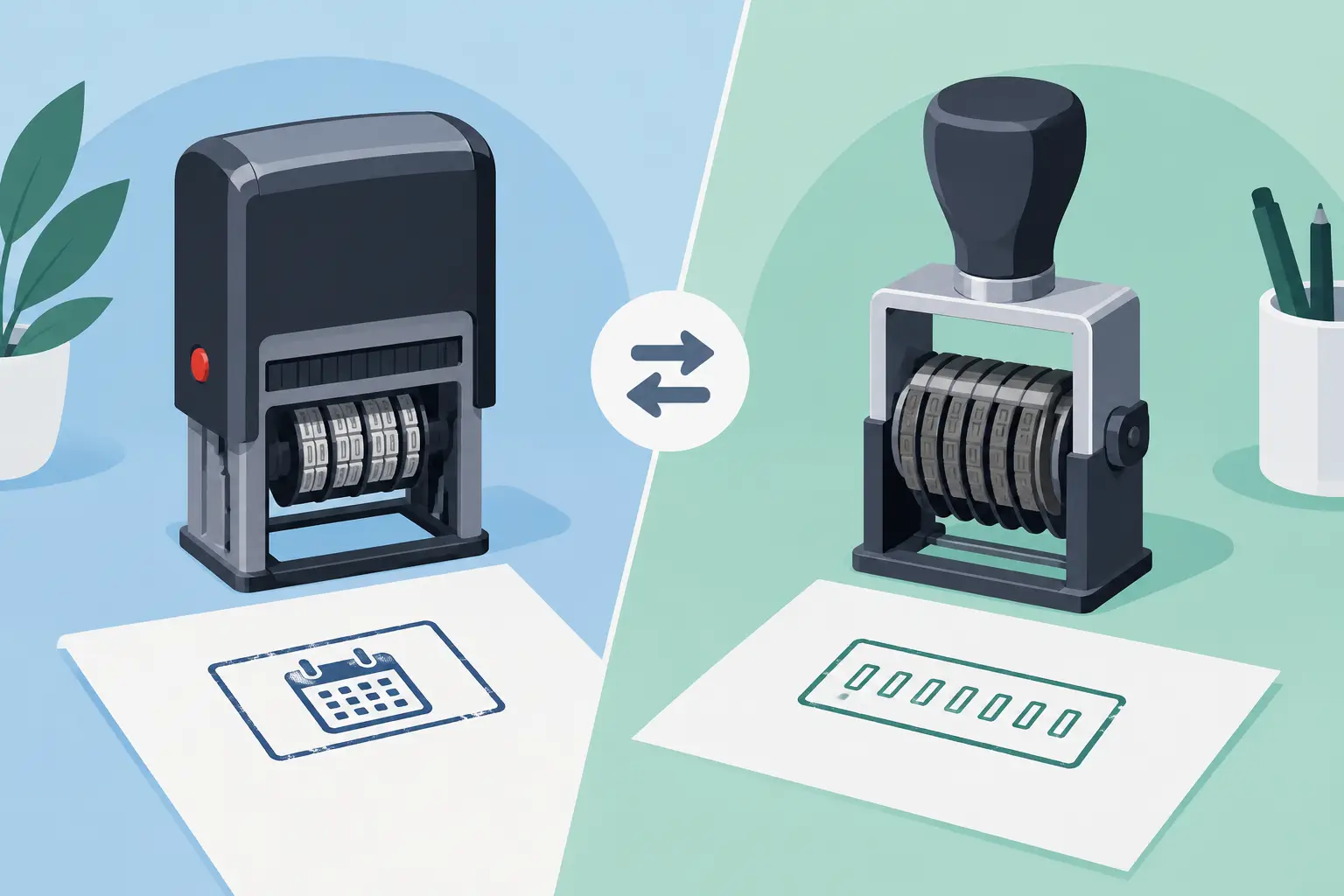
A delivery note arrives, a vehicle is booked in, a pupil’s work is marked or a document is received at the office. The choice between date stamps versus numbering stamps affects what that impression tells you later. One records when something happened. The other gives it a unique place in a sequence. Both save time, but they solve different administrative problems.
Choosing the right one is less about the stamp itself and more about the record you need to create. If a colleague needs to know when paperwork was processed, a date is the useful detail. If you need to trace ticket 00482, invoice 00483 and job card 00484 in order, numbering is what keeps the process controlled.
Date stamps versus numbering stamps: the key difference
A date stamp prints a changeable date, usually with separate bands for the day, month and year. It gives every document, item or record a clear time reference. This makes it particularly useful where receipt, approval, inspection or completion dates matter.
A numbering stamp prints a sequence of digits. Depending on the model, the user can set the number manually or use an automatic mechanism that advances after each impression. It is designed to identify items in a running order, rather than show when they were handled.
The distinction sounds simple, but it can prevent muddled records. A date on its own cannot tell you whether two similar forms are part of the same batch or which was processed first that day. A number on its own cannot show whether a job card was raised this week, last month or last year. The best choice depends on which gap in your workflow needs filling.
When a date stamp is the practical choice
Date stamps suit any task where timing needs to be visible at a glance. In a busy office, a received date stamp can show when post, applications, contracts or invoices entered the system. Staff do not need to write the date repeatedly, and the impression stays consistent even when several people handle the paperwork.
For schools, a date stamp can support classroom routines and administration. Teachers may use one to show when work was handed in or assessed, while office teams can date incoming forms and correspondence. The aim is not just tidiness. A clear date helps staff answer straightforward questions quickly, such as whether a permission slip was returned before a deadline.
Garages and workshops also benefit where service records need a visible point of reference. Dating an inspection sheet, warranty paperwork or a vehicle check record helps establish when work was carried out. This is especially useful when customers return with questions about recent work or when a team needs to review the order of jobs.
Retailers and stockroom teams may use date stamps for goods received, returns, quality checks and short-life stock. A handwritten date can be missed or misread, particularly when the pace is high. A clean stamped impression makes the information easier to spot.
What to check before choosing a date stamp
Start with the date format your business already uses. In the UK, day-month-year is generally the clearest option for internal paperwork, avoiding confusion with American-style month-first formats. Check the available year range too. A stamp that remains usable for several years offers better value than one that soon needs replacing.
Consider the space available on the document. A compact date stamp is useful for invoices, forms and labels with limited room, while a larger impression may be easier to read on job sheets, parcels or warehouse paperwork. If the date must stand out, coloured ink can help, although black or blue often suits formal records best.
It is also worth deciding whether the date needs extra wording. A simple date is ideal for general use, but labels such as RECEIVED, PAID, CHECKED or POSTED make the purpose immediately clear. For repeat office tasks, a personalised stamp with fixed wording and an adjustable date can remove another small but frequent step.
When numbering stamps work better
Numbering stamps are built for control and traceability. They are a sound choice when each form, ticket, voucher or job needs its own reference number. The number creates a trail that can be matched with a ledger, spreadsheet, digital record or duplicate copy.
A garage might number vehicle inspection sheets or repair job cards. If a customer calls about a particular repair, the reference number gives the team a quick way to locate the associated paperwork. For event organisers, numbering tickets, wristband records or raffle entries helps account for what has been issued. Small businesses may use numbered receipts, order slips or quality-control forms to keep processes orderly without relying entirely on handwritten references.
In professional services, numbering can support file management where documents move between team members. A sequence makes it easier to spot a missing page, identify the next form in a batch or reconcile paper copies with a register. The benefit is simple: every item has a clear identifier.
Manual or automatic numbering?
This is the main decision within the numbering stamp category. A manual numbering stamp lets you set the digits yourself. It works well where numbers change occasionally, such as a file reference, batch code or recurring form number. It gives flexibility, but someone must remember to adjust it correctly.
An automatic numbering stamp advances the number after an impression, or after a chosen number of impressions depending on the mechanism. This is usually the better option for high-volume, consecutive work such as ticketing, receipt books and serialised forms. It reduces the chance of duplicate numbers and keeps staff moving when there is a queue of paperwork.
Automatic models do need sensible handling. Check whether the stamp advances before or after printing, how many repeat impressions it can make on the same number, and whether leading zeroes are required. A five-digit sequence such as 00001, 00002 and 00003 often looks neater and is easier to sort than numbers with changing lengths.
Do you need both stamps?
Many workplaces do. A date stamp records the event, while a numbering stamp identifies the item. Together, they create a much stronger paper trail without making the process complicated.
Take a workshop job card. The date can show when the vehicle arrived or when work was completed. The job number connects that card to the customer record, parts used and invoice. In an office, incoming correspondence can be dated on arrival and given a reference number if it needs to be logged, assigned or followed up.
Using both is particularly helpful where documents may be copied, separated from their original file or reviewed weeks later. A date provides context; a number provides a route back to the detail. However, do not add both simply because they are available. If staff only need to prove when an invoice was received, a date stamp is quicker and less cluttered. If they are issuing sequential collection tickets, the number is the essential part.
For processes that repeatedly require both details in the same place, a bespoke stamp layout may be worth considering. This can include fixed wording, a space for a reference number or an adjustable date, depending on the information your team handles most often. The right layout should make the routine easier, not turn a straightforward mark into another decision for staff.
Choosing a stamp for daily use
The body style matters as much as the information on the impression. A self-inking stamp is often the most convenient option for desks, reception points and classrooms because the ink pad is built in. It produces quick, repeatable impressions and is generally cleaner for frequent use. Replacement pads can keep a well-used stamp working without replacing the whole unit.
Traditional hand stamps can be a sensible choice for occasional use or larger impressions, but they need a separate ink pad. That gives more freedom to change ink colours or use specialist inks for different surfaces, though it adds a step to each use.
Think about the surface as well. Standard document ink is intended for paper and card. If you are marking non-porous materials, packaging, metal or other specialist surfaces, the ink and stamp material need to suit the job. A clear impression on the wrong surface is not useful if it smudges, fades or transfers.
Finally, consider who will use the stamp. A reception team needs something simple enough for several people to use consistently. A workshop may need a durable stamp that can cope with regular handling. For a low-volume personal project, flexibility may matter more than automatic operation. Handy Stamps can help customers choose a practical option based on the wording, frequency and type of material involved.
The most useful stamp is the one that removes a repeated task without creating another one. Choose a date stamp when timing is the record that matters, a numbering stamp when sequence and traceability matter most, and both when your paperwork needs to show the full story.