A stamp that needs to be pressed into a separate ink pad soon becomes a nuisance when you are approving invoices, marking pupil work or updating service records all day. This automatic stamp review looks at the practical choice for repeated marking: the self-inking stamp. It is designed to produce a clean, consistent impression with one press, helping busy teams keep routine work moving.
For most workplace uses, an automatic stamp means a self-inking stamp rather than a battery-powered device. The wording plate turns onto an internal ink pad after each impression, ready for the next one. There is less handling, less mess and no need to stop and re-ink between every document.
What is an automatic stamp?
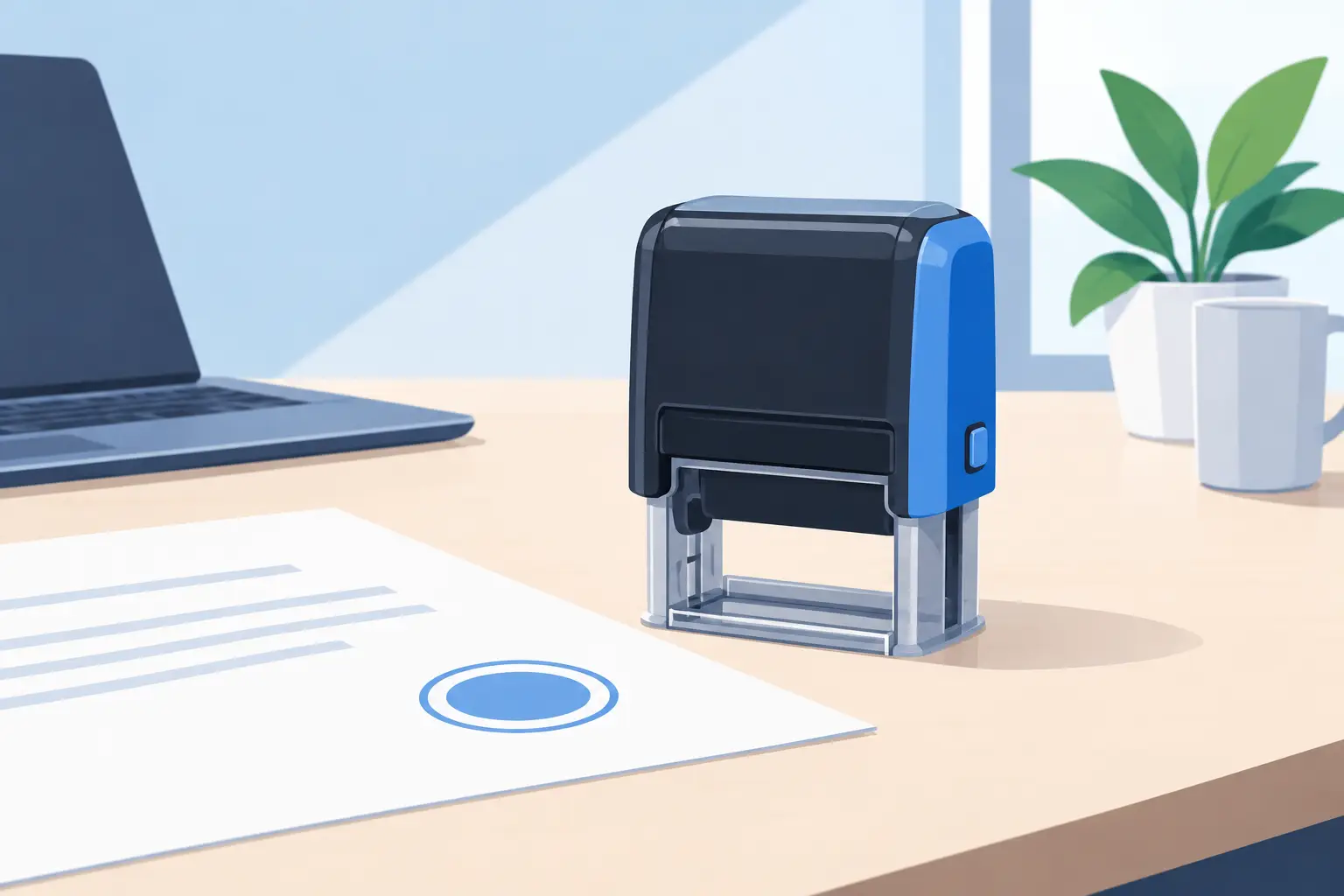
An automatic stamp has a built-in ink pad inside its casing. When the stamp is at rest, the rubber text plate sits against the pad. Press the stamp onto paper and the plate rotates down to make the impression, then returns to the pad as you release it.
That simple mechanism makes a noticeable difference where the same message is used repeatedly. A receptionist can mark correspondence as RECEIVED, a teacher can give clear feedback, and a garage can complete service book entries without reaching for a separate pad each time. The result is faster marking with more uniform results across a stack of paperwork.
Automatic stamps are usually supplied ready to use in a chosen ink colour. Black, blue, red, green and purple are common choices, although the right colour depends on your process. Red can make an urgent status stand out, while black or blue often suits records that need a professional, understated finish.
Automatic stamp review: the day-to-day benefits
The main benefit is speed, but it is not only about saving a few seconds. Repeated tasks are easier to manage when the tool is ready in one hand and produces the same message every time. That consistency can be useful for record keeping, customer-facing paperwork and classroom routines alike.
A self-inking mechanism also keeps the ink contained. Traditional hand stamps and separate pads still have their place, especially for large impressions or occasional use, but they require more care on a busy desk. An automatic stamp is generally cleaner to store, easier to pass between colleagues and less likely to leave ink on fingers, folders or worktops.
The casing protects the rubber plate when it is not being used. This matters in shared offices, school departments and workshops, where a stamp may be kept in a drawer or carried between workstations. Most models also include a lock for safe storage and for changing or refilling the ink pad.
There are limits. Self-inking stamps are best suited to standard paper and card rather than uneven, glossy or absorbent surfaces. If you need to mark packaging, fabric, timber, eggs or other specialist materials, you will need an ink and stamp body made for that surface. An automatic office stamp cannot do every job well, so matching it to the material is essential.
Where self-inking stamps make the most sense
Office teams often get the quickest return from an automatic stamp. Common messages such as PAID, COPY, CONFIDENTIAL, FILED, RECEIVED and APPROVED remove the need to write the same status by hand. For companies handling orders, forms or finance documents, this can make paper trails clearer and reduce small administrative delays.
In schools, ready-made teacher stamps can give pupils prompt, legible feedback without adding to marking time. Short messages such as Well Done, Excellent Effort or Please See Me are easy to recognise and can support a consistent approach across a class or department. A personalised name stamp can also help identify who has marked work where several staff members are involved.
Garages and workshops benefit from stamps that bring order to service records and job paperwork. Dates, mileage prompts, next-service details and business contact information can all be applied neatly. The best layout is usually one that supports the information already required on the form rather than trying to fit every possible detail into a small space.
Retailers, cafés and independent businesses use automatic stamps for loyalty cards, packaging slips and order checks. A compact logo or simple symbol can be effective, but small text must remain readable. On a loyalty card in particular, a bold shape often works better than a detailed design with fine lines.
What to check before you order
Start with the message you need to repeat most often. If people have to stop, read the stamp and work out whether it applies, the wording is probably too broad. A clear phrase such as INVOICE PAID or GOODS RECEIVED is more useful than a vague label that creates questions later.
Then consider the impression size. Small stamps suit dates, initials and short approval messages. Medium sizes work well for addresses, teacher comments and standard office wording. Larger formats allow more lines of text, but they need sufficient clear space on the document. A stamp that is too large for the form will create more problems than it solves.
Text layout affects legibility. Use a larger type size for the words people need to see first, and do not overcrowd the design. An address stamp may need a company name, address and telephone number, while a workshop stamp may need fewer words but a larger, clearer date area. A border can tidy the impression, although it is not always necessary.
Think about volume as well. For occasional use, a small self-inking stamp is convenient and economical. For high-volume administration, choose a durable model with a suitable pad capacity and an easily replaceable ink pad. The right body size should feel stable in the hand without being cumbersome to use hundreds of times.
Finally, check where the stamp will be used. Standard dye ink is ideal for ordinary paper, but not for every material. If the surface is coated, non-porous or handled outdoors, speak to the supplier about a specialist option. Choosing the correct ink at the outset is less costly than ordering a stamp that produces faint or smudged impressions.
Ink, refills and keeping impressions clean
A good automatic stamp should make many impressions before it needs attention, but it is not maintenance-free. When the print starts to look pale or uneven, replace or re-ink the pad using the correct ink for that stamp. Mixing inks or adding too much can lead to blurred impressions and ink leakage.
Keep the stamp closed and stored upright or flat in a clean, dry place. Avoid leaving it in direct sunlight, near a radiator or in a vehicle for long periods, as heat can affect the ink pad and casing. If dust or paper fibres collect on the rubber plate, gently clean it with a damp lint-free cloth and allow it to dry before use.
It is also worth testing a new custom stamp on spare paper before using it on important documents. This confirms the orientation, colour and pressure needed for a full print. Press firmly and evenly, then lift straight up. Rocking the stamp from side to side can soften the edges of the text.
When a different stamp type may be better
Automatic stamps are an excellent everyday choice, but they are not always the best answer. A traditional hand stamp with a separate pad can be more flexible for large designs, unusual inks or changing colours. It can also be a sensible option if the stamp is used only occasionally and you already have suitable ink pads.
Pre-inked stamps often produce very detailed impressions and can be especially neat for fine address text or logos. They tend to suit paper-based work, although they may take a little longer to dry than a standard self-inking impression. For events, hand stamps and specialist skin-safe inks are the appropriate route rather than an office-style self-inking stamp.
The useful question is not simply which stamp is best. It is which stamp makes your regular task quicker, clearer and easier to repeat. For routine paperwork, a well-designed automatic stamp is often the practical choice: keep the wording focused, choose the right size and ink, and it will earn its place on the desk from the first working day.