The school office is often where small delays become bigger problems: an unsigned form, an unclear payment record, a visitor without the right identification or a letter waiting to be processed. A guide to school administration stamps should therefore start with the everyday jobs that need a quick, consistent mark. The right stamps reduce handwriting, make paperwork easier to scan and help staff follow the same process when the reception desk is busy.
What school administration stamps are used for
Administrative stamps are different from classroom marking stamps. Their purpose is to move documents, records and visitors through a school clearly. A simple dated impression can show when a form arrived. A payment stamp can give office staff and parents a clearer record. A visitor stamp can support a more orderly sign-in process when used alongside the school’s own safeguarding procedures.
Common uses include incoming post, applications, consent forms, pupil records, invoices, purchase orders, trip paperwork, payment cards, library notices and internal circulation. The best wording depends on the system already in place. A stamp should reinforce a process, not create a separate one that only one member of staff understands.
For many schools, the most useful starting point is a small set of general office messages: RECEIVED, PAID, COPY, CONFIDENTIAL, ACTION REQUIRED and a date stamp. These cover a surprising number of tasks without filling drawers with rarely used tools.
Choose stamps around the workflow, not the catalogue
Before ordering, follow a typical document from arrival to filing. Ask who handles it, what decision is made, whether a date or initials are needed, and where it is stored afterwards. This reveals whether a short wording stamp is enough or whether a larger impression with fields is more useful.
For example, a simple RECEIVED stamp is suitable for letters and forms where the arrival date is the key detail. A payment record usually needs more space, perhaps for date, amount, method and initials. For an invoice approval process, a stamp with boxes for authorised by, cost centre and date can make checking easier before finance records the transaction.
Avoid putting too much into one design. Tiny boxes and long instructions may look comprehensive on screen but become hard to read on a busy paper form. If staff must write several lines of information, a larger traditional hand stamp may offer more room. If the message is short and repeated all day, a compact self-inking stamp is normally the more efficient choice.
Standard wording or personalised wording?
Ready-made wording works well for familiar office actions such as PAID, RECEIVED or CONFIDENTIAL. It is quick to introduce and easy for relief staff to recognise. Personalised wording is better where the stamp needs to match a school-specific form, department name or approval route.
A personalised stamp can also include the school name, telephone number or return address, but only include details that genuinely help. A full address stamp is useful for outgoing correspondence and book labels. It is less useful on internal paperwork where the school identity is already obvious.
Stamp types for a busy school office
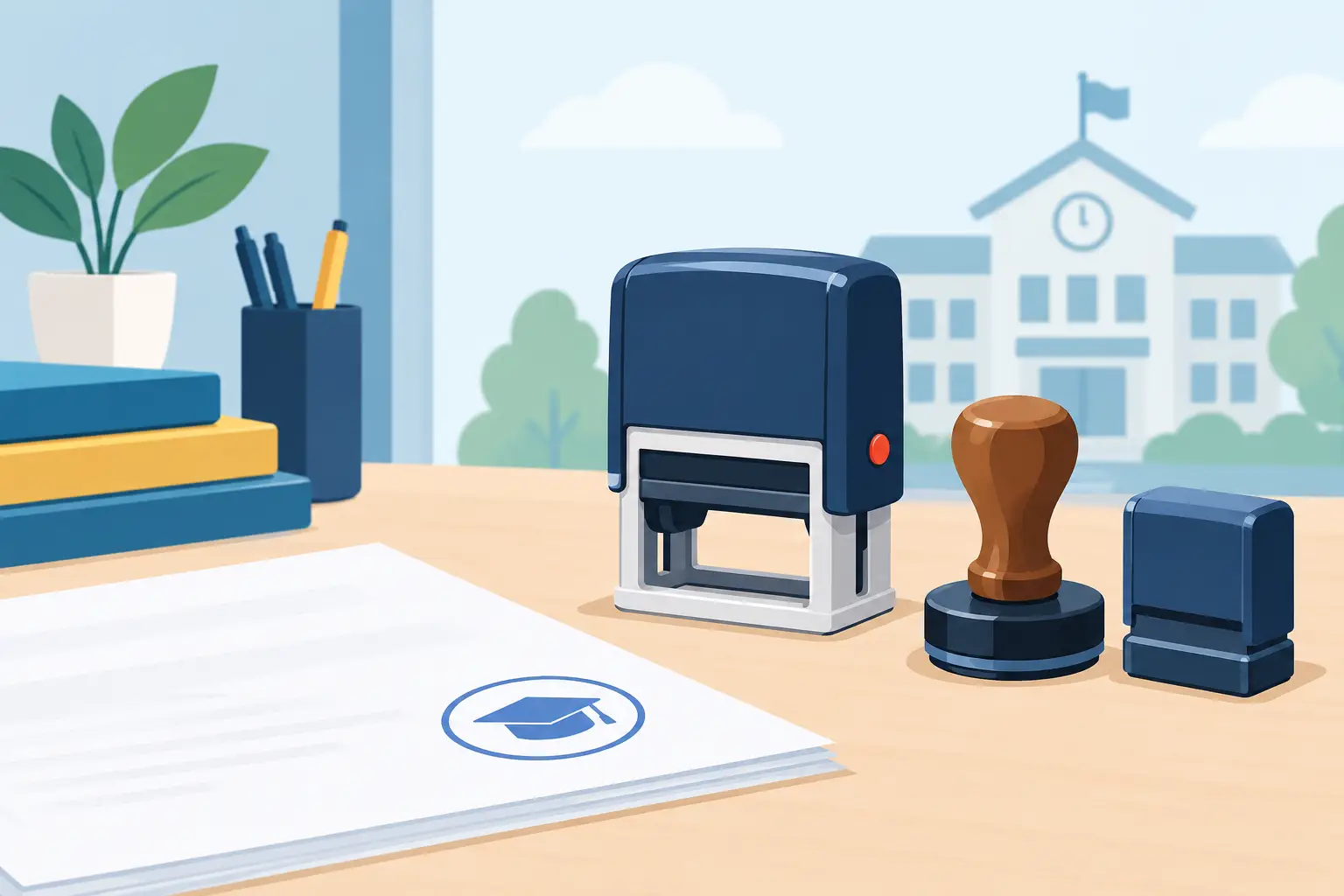
Self-inking stamps are often the practical choice for routine administration. The ink pad is built into the stamp, so the impression is quick, clean and consistent with no separate pad to manage. They suit reception desks, finance offices and departments that need the same wording repeatedly.
Traditional rubber stamps are a good option for larger designs, occasional use or specialist forms. They need a separate ink pad, which adds one small step, but they offer flexibility in ink colour and can be an economical choice for larger-format impressions. Keep the ink pad stored flat and closed when not in use to help prevent it drying out.
Date stamps deserve particular attention. A manually adjustable date stamp is useful wherever arrival, issue or approval dates matter. Choose one with a date format that is immediately clear to staff and families, such as 25 SEP 2026, rather than a numerical format that could be misread. Set a routine for changing the date at the start of each working day, particularly if several people use the same reception desk.
For departments that deal with confidential paperwork, a clearly marked CONFIDENTIAL stamp can be helpful. It should not be treated as a safeguarding control in itself, however. Sensitive records still need appropriate access, storage, retention and disposal procedures.
A practical guide to school administration stamp wording
Clear wording prevents hesitation. Staff should be able to understand the purpose of the mark at a glance, including someone covering reception during illness or a busy parents’ evening. Use plain terms and avoid abbreviations unless they are already established across the school.
Useful examples include:
- RECEIVED with a date line for letters, forms and documents handed in at reception.
- PAID, PART PAID or PAYMENT RECEIVED for clubs, meals, trips or other approved payment records.
- RETURN TO OFFICE for paperwork that has been sent to a classroom or department in error.
- ACTION REQUIRED for documents that need a named colleague to deal with them.
- COPY FOR FILE to show that a document should be retained with the relevant record.
- VISITOR, CONTRACTOR or DELIVERIES for local sign-in or pass processes where appropriate.
For payment stamps, be precise about what the mark proves. PAID can suggest that a full payment has been received, while PAYMENT RECEIVED is safer where a balance may remain. Similarly, an APPROVED stamp should only be used where the school has agreed who is authorised to approve the relevant item. The wording needs to reflect responsibility, not merely speed up the paperwork.
Size, ink colour and legibility
A stamp that is too large can obscure key information on a form. One that is too small can disappear among handwriting and printed boxes. Measure the available space on the documents used most often before choosing a size. It is worth printing a rough outline on paper to check that the impression will sit comfortably in the intended area.
Black or blue ink is usually the clearest choice for general office documents. Red can be useful for urgent actions or outstanding items, but should be reserved for a meaning that staff recognise consistently. Multiple colours may look organised at first, yet they can complicate reordering and confuse the process if they are not documented.
Legibility matters more than decoration. Choose a straightforward typeface, adequate spacing and enough contrast for photocopies and scans. If paperwork is likely to be copied in black and white, do not rely on colour alone to communicate status.
Introduce stamps without weakening record keeping
A stamp should make the process more reliable, not make it easier to skip steps. Decide where each stamp lives, who may use it and what staff need to add by hand. For some documents, an initial and date beside the impression gives a more useful audit trail than the stamp alone.
Keep a short reference sheet in the office or shared procedure folder. It can explain what each administrative stamp means, when it should be used and whether the document also needs to be entered on the school’s digital system. This is especially helpful when new administrators join or responsibilities move between staff.
Review the selection once a term or after a change to office procedures. If a stamp is barely used, it may not be needed. If staff are repeatedly writing the same phrase, that is a strong sign that a new stamp could save time and improve consistency.
Ordering for more than one department
Schools often benefit from buying a small standard range for reception, finance, attendance, pastoral teams and the headteacher’s office, then adding personalised stamps only where the process differs. Standardising common wording reduces training time and makes it easier to replace a stamp when it reaches the end of its working life.
For larger orders, confirm the wording and layout with the people who will use the stamp before it is made. A quick check of a proof against the actual form can prevent an avoidable mistake. It is also sensible to keep an agreed record of each design so that a replacement matches the original.
Handy Stamps can produce both practical stock wording and personalised designs, allowing schools to build a set that suits their own forms and routines. For urgent operational needs, checking dispatch times and approving the wording carefully can keep the order straightforward.
The most useful school administration stamps are rarely the most elaborate. They are the ones that make a repeated task clearer every time: a clean date on a received form, a visible payment record or a simple instruction that sends paperwork to the right person without delay.